FSO Related
- Details
- Written by: Kathy Bailey
- Category: FSO Related
- Hits: 65
Join FSO 45 minutes before wheels up
Tune to Channel 202 on VOX and Text
For Bouncer announcements Tune and use Channel = 903
Bouncer Tasks
- Monitor Roster for pilots out of uniform and inform them they must be in a squad to fly this event
Statements examples to use when interacting with pilots out of uniform
- Direct message when not in uniform
○ What squad
- Direct message when pilot asks for squad to join
○ You must contact and be accepted to fly with a squad prior to FSO
○ You can contact squads via the BBS
Tasks and Messages
BC = send to arena on Bouncer Channel (903)
10:45EST (BC)
You must show on roster with a registered Squad to fly this event
Ask CM if logs are started
10:55EST (BC)
All Pilots not in a registered Squad will be grounded at launch
11:00EST (BC)
*You must show on roster with a registered Squad to fly this event
*At launch…. Please de-tune Chanel 200 for the event
***********************************************************************************
***********************************************************************************
Command Cheat Sheet
.ground <GameID>
Example: .ground Phast
.warn <Game ID>
Example: .warn Phast
.mute <Game ID>
Example: .mute Phast
.eject <Game ID>
Example: .eject Phast
--created by Phast
--made pretty by Kanth
- Details
- Written by: Spikes
- Category: FSO Related
- Hits: 66
Introduction
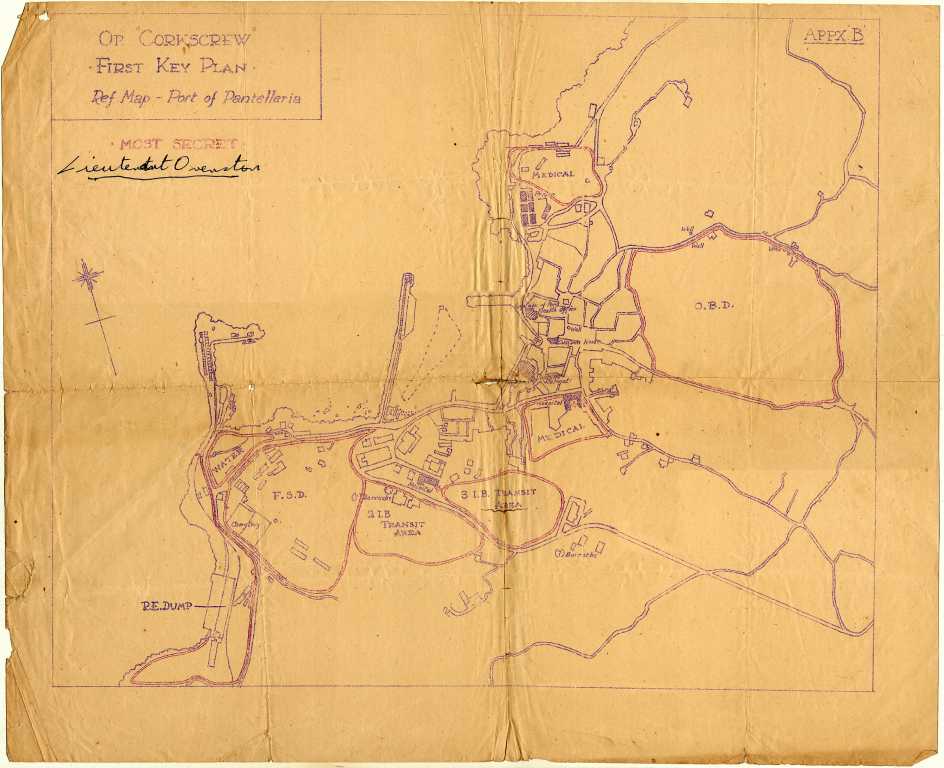
Operation Corkscrew was the code name for the Allied invasion of the Italian island of Pantelleria (between Sicily and Tunisia) on 11 June 1943, prior to the Allied invasion of Sicily during the Second World War. There had been an early plan to occupy the island in late 1940 (Operation Workshop),[but this was aborted when the Luftwaffe strengthened the Axis air threat in the region.
The Allied focus returned to Pantelleria in early 1943. The radar installations and airfield on the island were seen as a real threat to the planned invasion of Sicily (codenamed Operation Husky). The Italian garrison on the island was 12,000 strong in well-entrenched pillboxes and 21 gun batteries of a variety of calibers. In addition, there was an opportunity to assess the impact of bombardment upon heavily fortified defenses. It was decided to see if the island could be forced into submission by aerial and naval bombardment alone. Failing this, an amphibious invasion was planned for 11 June.
Starting in late May, the island was subjected to steadily increasing bombing attacks. In early June, the attacks intensified and 14,203 bombs amounting to 4,119 tons were dropped on 16 Italian batteries. On 8 June, a Royal Navy task force of five cruisers, eight destroyers and three torpedo boats carried out a bombardment of the main port on the island.
The engagement was observed by General Dwight D. Eisenhower, the Supreme Allied Commander in the Mediterranean, and Admiral Andrew Cunningham from the flagship HMS Aurora. From 8 May to 11 June 5,285 bombing sorties were flown by fighter-bombers, medium and heavy bombers, dropping a total of 6,202 tons of bombs on the island.
Two demands for the garrison to surrender went unanswered and, on 11 June, the amphibious assault went ahead. About an hour before the landing craft reached the beaches, the accompanying ships opened fire. Unknown to the attackers, the commander of the garrison on Pantelleria had sought permission to surrender from Rome the previous evening and received it that morning.[3] When the first of the British Commandos landed, the Italians surrendered. The British Prime Minister, Winston Churchill, was to record later in his memoirs that the only British casualty of the operation was a man bitten by a mule.
An assessment by British analyst Professor Sir Solly Zuckerman reported that the defenses had been reduced to 47 percent effectiveness. The intense ten-day air bombardment had substantially reduced the defenses. Out of 80 guns bombed, 43 were damaged (10 beyond repair). All control communications were destroyed, along with many gun emplacements, ammunition stores and air-raid shelters. The ease of the operation led to an optimistic assessment of the effectiveness of bombing, which was not always borne out in practice.
The Italian garrisons on other nearby islands (Lampedusa and Linosa) quickly fell. This cleared the way for the invasion of Sicily a month later.
Please join the FSO Team for this mid years war special event featuring the USAAF vs the Luftwaffe in Pantelleria 1943.
Side Split
Axis 50%
Allies 50%
Planeset
|
Axis |
Allies |
||||
|
Aircraft |
Min - Max |
location |
Aircraft |
Min - Max |
location |
|
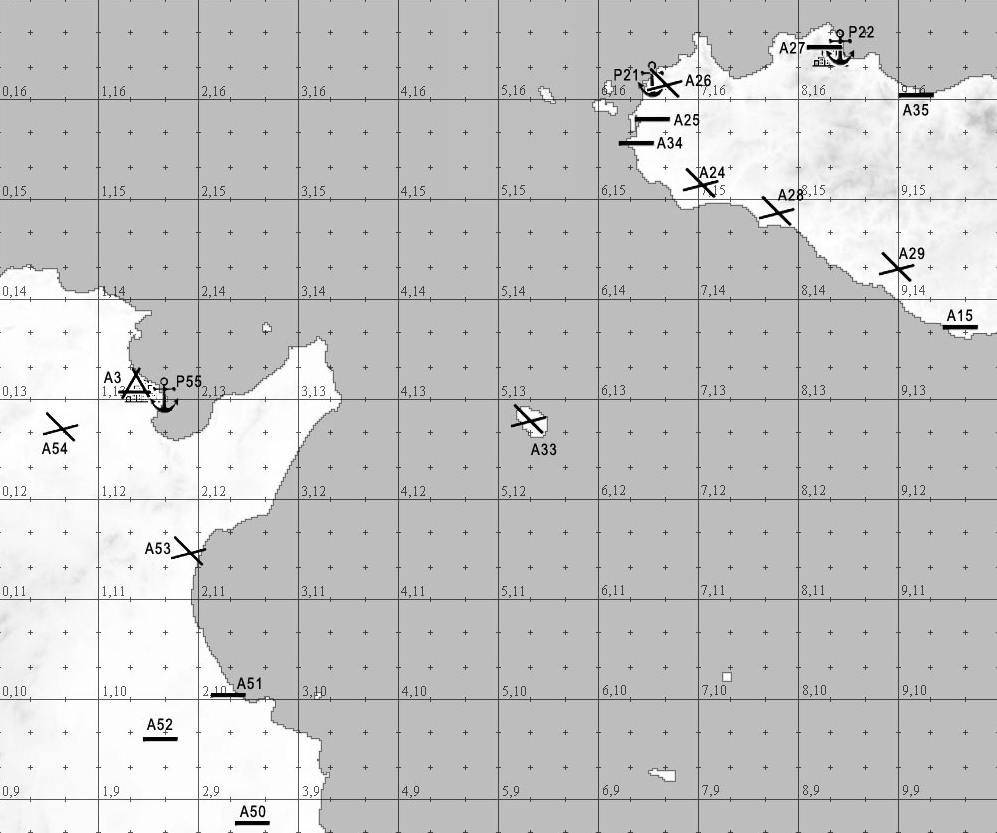
Macchi 202 |
Unlimited |
A33 |
P-40F |
Unlimited |
A51 |
|
Macchi 205 |
Max 6 |
A33 |
P-38G |
Max 36 |
A54 |
|
BF109G-2 |
Max 36 |
A29 |
Spitfire IX |
Max 18 |
A3 |
|
BF109G-6 |
Max 12 |
A25 |
B-26B |
Min 6 |
A53 |
|
JU88A-4 |
Min 12 |
A24 |
B-25C |
Min 6 |
A3 |
Ordnance Distribution
Axis
JU88A-4 - Ext. [2x] or [4x] 250 kg bombs, Int. 20 kg bombs or [2x] F5B Torpedoes
Allies
B-26B - Int. [8x] 500 lb. bombs
B-25C- Int. [6x] 500 lb. bombs
Terrain
Special Event Rules and Ordnance Restrictions
- This is a one life event. Pilots may not re-plane at their home or other airfields.
- Ordnance for each aircraft will be set by the setup CM in the hangar.
- Aircraft may rearm and refuel at any friendly base. Aircraft should be landed before frame’s end at any friendly base.
- All assaults must be made by no less than 12 attacking aircraft.
- All destroyed objects stay down for the entire frame.
- All Hangars, Cruisers and Destroyers will have the same destruction weight of 2800 lbs.
- The Aircraft carriers will be removed from any target fleets.
- All bomber aircraft will be restricted to an altitude not exceed 18k.
- Fighter aircraft may not attack ground targets.
- The Allies may control the stirring of their fleet within the assign cruise area.
Targets and Scoring
Allied Targets = [4] Bomber Hangars [3] Fighter Hangars [1] Vehicle Hangar
Axis Targets = [2] Cruisers and [6] Destroyers
Single Engine Fighter - 1 pt.
Multi-Engine Bomber - 2 pts.
Hangars =10 pts.
Ships = 10 pts.
Arena Settings
- Terrainmap: Malta
- Fuel burn rate: 1.0
- Anti-aircraft gun strength: 0.5
- Bombsight calibration: AUTOMATIC (MA standard)
- Icons: 3.0K yards (9,000 feet)
- Sector Radar ("bar dar"): OFF
- Dot Radar: OFF
- Fighter and Bomber warning range: 26,400 feet (5 miles)
- Tower range set to 26,400 feet (for display only, to match the above setting)
- Haze range: 12 miles
- Friendlycollisions: OFF
- Enemy collisions: ON
- Kill shooter: OFF
- Stall Limiter: Set ON (Players may disable)
Wind:
Altitude Speed Direction
00 - 02K 0 NO WIND
02 - 10K 05 W -> E
10 - 18K 13 W -> E
18 - 26K 27 W -> E
26 - 30K 38 W -> E
30K+ -199 DOWNDRAFT
Arena Clock:
Frame 1 05:45 (7:00 AM, Morning)
Frame 2 11:00 (11:00 AM, Morning)
Frame 3 14:00 (3:00 PM, Afternoon)
ACE MISSIONS
Each side will have one mandatory Ace mission per frame. These frames will represent notable pilots of the time and theater. One pilot from each side will be designated an "Ace" Pilot. They must fly the Aces listed aircraft. The Aces must be relayed to the Admin CM before launch. They will be scored as follows.
Ace Pilot = 20 Points (Opponent Score)
Ace Pilot Kills = 20 Points
So for example if an Ace Pilot is shot down they are worth 20 points to the other side. Like wise, every victory an Ace Pilot lands they will be rewarded 20 points.
Axis
Frame 1 - BF109G-6 Oberleutnant Ernst Wilhelm Reinert, Staffwlkaptain 1./JG 77 – Emerging as the top-scoring pilot of the Tunisian campaign Reinert achived 51 kills from January to April of 1943. His G-6 wore the Geschwader badge, introduced in April 1943, which gave the unit its name of JG 77 ‘Herz-As’(Ace of Hearts). By war’s end Hauptmann Reinert was in charge of IV/JG27 and had scored 174 aerial kills with an additional 16 on the ground.
Frame 2 – BF109G-2 Feldwebel Anton Hafner 4./JG 51 – Hafner had already scored 62 kills in Russia before reporting to /JG 51 in Sardinia. He added an additional 20 kills to his record in the Mediterranean. Shortly there after being commissioned and officer of the Luftwaffe and reported to III. /JG 51 on the Eastern Front. He was killed in action over East Prussia on 17 June 1944 in a dogfight at low altitude with a Yak-9. Despite being lost almost a year before the end of the war, Hafner’s outstanding score of 204 kills was never exceeded by another /JG 51 pilot.
Frame 3 – C205 Segenta Maggiore Luigi Gorinni 3◦ Stormo - was an Italian World War II fighter pilot in the Regia Aeronautica and in the Aeronautica Nazionale Repubblicana. During the conflict he flew with the Corpo Aereo Italiano (CAI, Italian Air Corps) during the Battle of Britain, fought over Libya and Tunisia, and was involved in the defence of the Italian mainland. Gorrini was credited with 19 (24 according to some sources) enemy planes shot down plus 9 damaged, of several types: Curtiss P-40, Spitfire, P-38 Lightning, P-47 Thunderbolt, B-17 "Flying Fortress" and B-24 Liberator. He claimed his air victories flying the biplane Fiat C.R.42 and monoplanes Macchi C.202 and C.205 Veltro. Gorrini was the top scoring C.205 pilot. With the Veltro he shot down 14 enemy planes and damaged six more.[1] He was the highest ranking Italian ace still alive until his death, and the only surviving fighter pilot awarded the Medaglia d'Oro al Valor Militare (Gold Medal of Military Valor).
Allies
Frame 1 – P-40F Lt. Colonel Hershel “Herky” Green 325th FG - Green served with the 317th FS, 325th Fighter Group, 15th AF. Top ace of the "Checkertail Clan" with 18 air victories, (3 in P-40s, 10 in P-47s, 5 in P-51s), plus 10 destroyed on the ground. Total Combat Sorties: 100.
On August 17, 1943, the Allies captured Sicily, leaving no targets for the 325th except for some Italian forces on Sardinia, against which the Group began bombing missions with their P-40s. Knowing that the Italians on Sardinia were nearly at the end of their resources, and imagining headlines like "FIGHTER GROUP CAPTURES ENEMY ARMY," the 325th dropped surrender demands to the Italian commander on Sardinia. (He apparently resisted these, and eventually surrendered to regular Allied ground armies.)
Frame 2 – P-38G Lt. “Ricky” Zubarik 82nd FG – By May 13 1943 Zubarik had become an ace scoring his 6th kill on the 21st of May. Lt. Zubarik’s P-38G named Pearl III had donned 6 swastikas for his six kills. It also had donned 2 question marks as the Lt. was caught up in a dogfight with two ME 410s that collided into his Lightning. He did not receive credit for those aircraft and two day later Lt. Zubarik was shot down over Sardinia and made a POW.
Frame 3 – Spitfire IX Wing Commander Lance Cleo "Wildcat" Wade DSO, DFC & Two Bars (1915 – 12 January 1944) was an American pilot who joined the Royal Air Force (RAF) during World War II and became a flying ace. He remained with RAF until his death in a flying accident in 1944 in Italy. In 30 fights for which he made claims he was credited with 23 victories (including two shared), one probable, and 13 damaged.
Designer Notes:
Designed by – AKWarHwk August 2017
- Details
- Written by: Spikes
- Category: FSO Related
- Hits: 68
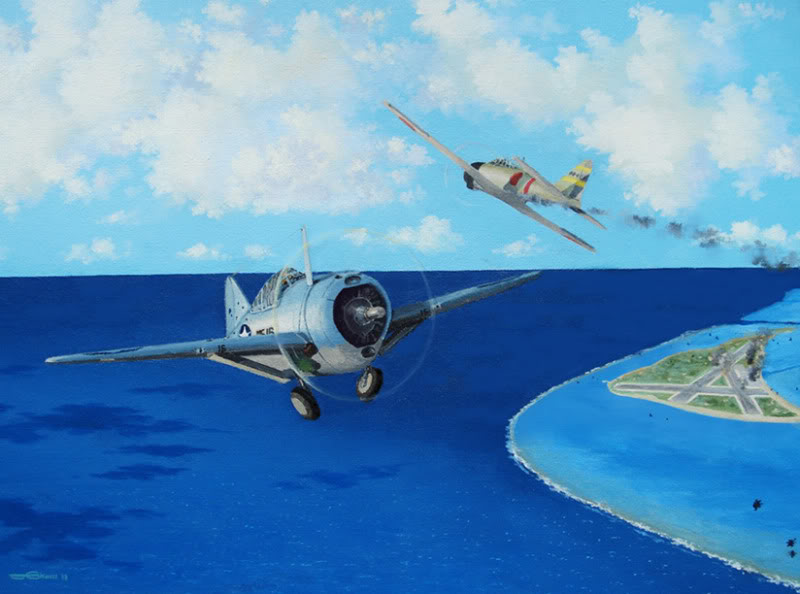 Head On at Midway 1942
Introduction
At 0300 4 June, when reveille sounded on Midway, the Japanese Fleet was
approaching its objective in two main forces, the Striking Force, commanded by
Admiral Nagumo, Chuichi, IJN; and the Occupation Force, under over-all command
of Vice Admiral Kondo, Nobutake, IJN. The former unit, as we have seen, was
composed of four carriers, plus an escort of battleships and smaller combatant
ships; and the latter included a substantial portion of the Second Fleet:
Battleships, cruisers, and the amphibious shipping necessary to mount the
projected landing operation against Midway, the objective now designated by
the Japanese code term as "AF."
At this time the striking force was approximately 250 miles northwest of
the atoll, engaged in making final preparations to launch planes which were
intended to wipe out Midway as an effective air base and pave the way for
its assault and occupation. The occupation force, which had been attacked from
the air without appreciable damage during the day and night previous, was
almost due west of Midway, approximately 450 miles away.
At 0430, only 15 minutes after an early dawn search group of 11 PBY's had
been sent out from Midway to locate his Striking Force, Admiral Nagumo headed
carriers upwind and launched the Midway Attack Force, composed as follows:
First wave: 36 carrier attack planes.
Second wave: 36 carrier bombers.
Third wave: 36 fighters.
Meanwhile, after the PBY's had gone out, Midway devoted itself to final
preparations for battle. Marines of the ground defense force were at general
quarters, manning every weapon and warning device; the pilots and ground
crews of MAG-22, which already had fighters aloft to cover the sortie of
the PBY's, were standing by for orders. The latter were not long in coming.
At 0552, moreover, after apparently trying to get this vital message
through for almost a quarter of an hour (see footnote 6), a PBY reported
visual contact with two enemy carriers and the balance of the Japanese main
body, some 180 miles from Midway, bearing 320 degrees.
Three minutes later, at 0555, the 6th Defense Battalion logged a radar
report, "Many planes, 89 miles, 320 degrees." Almost simultaneously, the
Naval Air Station noted substantially the same contact. In a matter of
seconds, the air-raid sirens were sounding, Condition One was set, and the
pilots of MAG-22 were manning their planes.
Within less than 10 minutes, both squadrons of the Marine Air Group
were in the air and being vectored toward their respective targets. VMF-221
was to intercept the massed carrier air of the Midway attack force, and
VMSB-241 would rendezvous 20 miles east of Midway, at which point further
instructions would be issued.
Commanded by Major Floyd B. Parks, VMF-221 was a squadron of mixed
composition, being equipped mainly with Brewster F2A-3's, augmented
by a few F4F-3's of the type which had already drawn blood at Wake.
On this morning, 26 airplanes were operational out of the squadron's 28.
At 0616, approximately 30 miles from Midway, from an altitude of 14,000
feet, the pilots with Major Parks saw 2,000 feet below them a large formation
of Aichi Type 99 (Val) dive bombers screened by several divisions of Zero
fighters. Captain John F. Carey, leading one of Park's divisions in an F4F-3,
gave "Tally-ho," and pushed over into a dive to attack the bombers, followed
by his wingmen, Captain Marion E. Carl and Second Lieutenant Clayton M.
Canfield. As Carey and Canfield commenced high-side runs on the bombers, Carl
and other pilots of the squadron mixed it with a swarm of Zero fighters which,
they noted, climbed astoundingly even in comparison to the Grumman's, let
alone the F2A's.
Inasmuch as only three of the original 12 Marine pilots of Major Park's
group survived this unequal encounter, it is impossible to reconstruct
details of the melee, but survivors' accounts, together with evident results
observed subsequently, indicate that the first attack took a formidable toll
of the enemy bombers and even a few of the 36 covering Zeroes.
Join the Aces High FSO Team as we present a different look a the Battle of
Midway. That pits man a machine against each other in a desperate battle
to attack and defend the Island of Midway.
Side Split
Axis 50%
Allies 50%
Planeset
Axis
Mitsubishi A6M2 Unlimited
Mitsubishi A6M3 (12) Max
Aichi D3A1 (12) Min
Nakajima B5N2 (12) Min
Allied
Brewster F2A Unlimited
Grumman F4F-3 (12)
Dauntless SBD-5 (12)
Grumman TBM-3 (12)
Ordnance Distribution (Loadouts)
Axis
Aichi D3A1 - 1x 250kg bomb, 2x 50kg bombs
Nakajima B5N2 - 1x 800kg torpedo or 3x 250kg (550lb) bombs
Allies
Dauntless SBD-5 - 1x 500lb bomb and 2x 100lb bombs
Grumman TBM-3 - 1x 2000lb torpedo or 4x 500lb bombs
Terrain
Head On at Midway 1942
Introduction
At 0300 4 June, when reveille sounded on Midway, the Japanese Fleet was
approaching its objective in two main forces, the Striking Force, commanded by
Admiral Nagumo, Chuichi, IJN; and the Occupation Force, under over-all command
of Vice Admiral Kondo, Nobutake, IJN. The former unit, as we have seen, was
composed of four carriers, plus an escort of battleships and smaller combatant
ships; and the latter included a substantial portion of the Second Fleet:
Battleships, cruisers, and the amphibious shipping necessary to mount the
projected landing operation against Midway, the objective now designated by
the Japanese code term as "AF."
At this time the striking force was approximately 250 miles northwest of
the atoll, engaged in making final preparations to launch planes which were
intended to wipe out Midway as an effective air base and pave the way for
its assault and occupation. The occupation force, which had been attacked from
the air without appreciable damage during the day and night previous, was
almost due west of Midway, approximately 450 miles away.
At 0430, only 15 minutes after an early dawn search group of 11 PBY's had
been sent out from Midway to locate his Striking Force, Admiral Nagumo headed
carriers upwind and launched the Midway Attack Force, composed as follows:
First wave: 36 carrier attack planes.
Second wave: 36 carrier bombers.
Third wave: 36 fighters.
Meanwhile, after the PBY's had gone out, Midway devoted itself to final
preparations for battle. Marines of the ground defense force were at general
quarters, manning every weapon and warning device; the pilots and ground
crews of MAG-22, which already had fighters aloft to cover the sortie of
the PBY's, were standing by for orders. The latter were not long in coming.
At 0552, moreover, after apparently trying to get this vital message
through for almost a quarter of an hour (see footnote 6), a PBY reported
visual contact with two enemy carriers and the balance of the Japanese main
body, some 180 miles from Midway, bearing 320 degrees.
Three minutes later, at 0555, the 6th Defense Battalion logged a radar
report, "Many planes, 89 miles, 320 degrees." Almost simultaneously, the
Naval Air Station noted substantially the same contact. In a matter of
seconds, the air-raid sirens were sounding, Condition One was set, and the
pilots of MAG-22 were manning their planes.
Within less than 10 minutes, both squadrons of the Marine Air Group
were in the air and being vectored toward their respective targets. VMF-221
was to intercept the massed carrier air of the Midway attack force, and
VMSB-241 would rendezvous 20 miles east of Midway, at which point further
instructions would be issued.
Commanded by Major Floyd B. Parks, VMF-221 was a squadron of mixed
composition, being equipped mainly with Brewster F2A-3's, augmented
by a few F4F-3's of the type which had already drawn blood at Wake.
On this morning, 26 airplanes were operational out of the squadron's 28.
At 0616, approximately 30 miles from Midway, from an altitude of 14,000
feet, the pilots with Major Parks saw 2,000 feet below them a large formation
of Aichi Type 99 (Val) dive bombers screened by several divisions of Zero
fighters. Captain John F. Carey, leading one of Park's divisions in an F4F-3,
gave "Tally-ho," and pushed over into a dive to attack the bombers, followed
by his wingmen, Captain Marion E. Carl and Second Lieutenant Clayton M.
Canfield. As Carey and Canfield commenced high-side runs on the bombers, Carl
and other pilots of the squadron mixed it with a swarm of Zero fighters which,
they noted, climbed astoundingly even in comparison to the Grumman's, let
alone the F2A's.
Inasmuch as only three of the original 12 Marine pilots of Major Park's
group survived this unequal encounter, it is impossible to reconstruct
details of the melee, but survivors' accounts, together with evident results
observed subsequently, indicate that the first attack took a formidable toll
of the enemy bombers and even a few of the 36 covering Zeroes.
Join the Aces High FSO Team as we present a different look a the Battle of
Midway. That pits man a machine against each other in a desperate battle
to attack and defend the Island of Midway.
Side Split
Axis 50%
Allies 50%
Planeset
Axis
Mitsubishi A6M2 Unlimited
Mitsubishi A6M3 (12) Max
Aichi D3A1 (12) Min
Nakajima B5N2 (12) Min
Allied
Brewster F2A Unlimited
Grumman F4F-3 (12)
Dauntless SBD-5 (12)
Grumman TBM-3 (12)
Ordnance Distribution (Loadouts)
Axis
Aichi D3A1 - 1x 250kg bomb, 2x 50kg bombs
Nakajima B5N2 - 1x 800kg torpedo or 3x 250kg (550lb) bombs
Allies
Dauntless SBD-5 - 1x 500lb bomb and 2x 100lb bombs
Grumman TBM-3 - 1x 2000lb torpedo or 4x 500lb bombs
Terrain
 Special Event Rules and Ordnance Restrictions
• This is a one life event. Pilots may not re-plane at their home airfields.
• Ordnance for each aircraft will be set by the setup CM in the hangar.
• Aircraft may rearm and refuel at any friendly base. Aircraft should be
landed before frame’s end at any friendly base.
• All assaults must be made by no less than 12 attacking aircraft.
• All destroyed objects stay down for the entire frame.
• All Hangars, Cruisers and Destroyers will have the same destruction
weight of 2800 lbs.
• The Aircraft carriers will have a destruction weight of 10,000 lbs.
• Aircraft icons appear above 18k.
• Altitude CAP for aircraft carrying bombs will be 18k.
Scoring
Single Engine Fighter - 1 pt.
Single Engine Attack - 2 pts.
Hangars =10 pts.
Ships = 10 pts.
Arena Settings
•Terrainmap: Midway
•Fuel burn rate: 1.0
•Anti-aircraft gun strength: 0.5
•Bombsight calibration: AUTOMATIC (MA standard)
•Icons: 3.0K yards (9,000 feet)
•Sector Radar ("bar dar"): OFF
•Dot Radar: OFF
•Fighter and Bomber warning range: 26,400 feet (5 miles)
•Tower range set to 26,400 feet (for display only, to match the above setting)
•Haze range: 12 miles
•Friendlycollisions: OFF
•Enemy collisions: ON
•Kill shooter: OFF
•Stall Limiter: Set ON (Players may disable)
Wind:
Altitude Speed Direction
00 - 02K 0 NO WIND
02 - 10K 05 W -> E
10 - 18K 13 W -> E
18 - 26K 27 W -> E
26 - 30K 38 W -> E
Arena Clock:
Frame 1 05:45 (6:00 AM, Morning)
Frame 2 11:00 (11:00 AM, Morning)
Frame 3 14:00 (3:00 PM, Afternoon)
ACE MISSIONS
Each side will have one mandatory Ace mission per frame. These frames will
represent notable pilots of the time and theater. One pilot from each side
will be designated an "Ace" Pilot. They must fly the Aces listed aircraft.
The Aces must be relayed to the Admin CM before launch. They will be scored
as follows.
Ace Pilot = 20 Points (Opponent Score)
Ace Pilot Kills = 20 Points
So for example if an Ace Pilot is shot down they are worth 20 points to the
other side. Likewise, every victory an Ace Pilot lands they will be rewarded
20 points.
IJN/IJA
Frame 1 - A6M2 Zero - Shimakawa Masaaki was a warrant officer and ace fighter
pilot in the Imperial Japanese Navy (IJN) during the Pacific theater of World
War II. In aerial combat over the Pacific he was officially credited with
destroying eight enemy aircraft with 12 or 13 assists. Shimakawa was a member
of the Tainan Air Group at the beginning of the Pacific War. Often assigned
as a wingman to legendary ace Saburō Sakai, Shimakawa fought in the conquest
of the Philippines and the Dutch East Indies campaign. In April 1942, Shimakawa
was transferred to the aircraft carrier Kaga's fighter group, with which he
participated in the Battle of Midway.
Frame 2 - A6M2 Zero - Kaname Harada was a Japanese flying ace of World War II.
He was credited with shooting down as many as 19 Allied aircraft between late
1941 and when he was himself downed in October 1942. During the Battle of
Midway, Harada shot down either three or five American aircraft. After recovering
from the injuries sustained in this incident, Harada served as a flying instructor
for the remainder of the war.
Frame 3 - A6M3 Zeke - Iyozoh or Iyozo Fujita was a Japanese Lieutenant Commander
in the Imperial Japanese Navy Air Service during World War II. He was credited
with 11 to 42 victories.
USN/USMC
Frame 1 - F2A Buffalo - Charles Kunz was born on November 7, 1919, in Dixon,
Missouri. He enlisted in the U.S. Marine Corps on November 15, 1940, and
entered the Aviation Cadet Program on February 15, 1941. Kunz was commissioned
a 2d Lt in the Marine Corps and designated a Naval Aviator on September 6, 1941,
and then completed fighter training at San Diego, California, before joining
VMF-221 at Midway in February 1942. Lt Kunz was credited with the destruction of
2 enemy aircraft during the Battle of Midway while flying the F2A-3 Buffalo on
June 4, 1942. He was wounded in this action, and joined VMF-224 in Hawaii the
same month. Lt Kunz deployed to Guadalcanal in August 1942, and was credited
with the destruction of another 6 enemy aircraft in aerial combat flying the
F4F-4 Wildcat before returning to the U.S. in November 1942.
Frame 2 - F2A Buffalo - Marine Lieutenant Colonel Marion Carl, one of the war’s
acclaimed fighter aces in his own right with 18½ kills to his credit. The first
of these came on June 4, 1942, when Captain Carl was assigned to Marine Fighting
Squadron (VMF) 221 on Midway Atoll. He had arrived there on Christmas Day in 1941,
flying an F2A-3 Buffalo from the carrier Saratoga (CV 3).
Frame 3 - F4F -3 Wildcat - Colonel James E. Swett United States Marine Corps fighter
pilot and ace during World War II. He was awarded the United States' highest military
decoration, the Medal of Honor, for actions while a division flight leader in VMF-221
over Guadalcanal on April 7, 1943. Subsequently he downed a total of 15.5 enemy aircraft
during the war, earning eight Distinguished Flying Crosses and four Air Medals.
Designer Notes:
Designed by – AKWarhwk June 2017
Special Event Rules and Ordnance Restrictions
• This is a one life event. Pilots may not re-plane at their home airfields.
• Ordnance for each aircraft will be set by the setup CM in the hangar.
• Aircraft may rearm and refuel at any friendly base. Aircraft should be
landed before frame’s end at any friendly base.
• All assaults must be made by no less than 12 attacking aircraft.
• All destroyed objects stay down for the entire frame.
• All Hangars, Cruisers and Destroyers will have the same destruction
weight of 2800 lbs.
• The Aircraft carriers will have a destruction weight of 10,000 lbs.
• Aircraft icons appear above 18k.
• Altitude CAP for aircraft carrying bombs will be 18k.
Scoring
Single Engine Fighter - 1 pt.
Single Engine Attack - 2 pts.
Hangars =10 pts.
Ships = 10 pts.
Arena Settings
•Terrainmap: Midway
•Fuel burn rate: 1.0
•Anti-aircraft gun strength: 0.5
•Bombsight calibration: AUTOMATIC (MA standard)
•Icons: 3.0K yards (9,000 feet)
•Sector Radar ("bar dar"): OFF
•Dot Radar: OFF
•Fighter and Bomber warning range: 26,400 feet (5 miles)
•Tower range set to 26,400 feet (for display only, to match the above setting)
•Haze range: 12 miles
•Friendlycollisions: OFF
•Enemy collisions: ON
•Kill shooter: OFF
•Stall Limiter: Set ON (Players may disable)
Wind:
Altitude Speed Direction
00 - 02K 0 NO WIND
02 - 10K 05 W -> E
10 - 18K 13 W -> E
18 - 26K 27 W -> E
26 - 30K 38 W -> E
Arena Clock:
Frame 1 05:45 (6:00 AM, Morning)
Frame 2 11:00 (11:00 AM, Morning)
Frame 3 14:00 (3:00 PM, Afternoon)
ACE MISSIONS
Each side will have one mandatory Ace mission per frame. These frames will
represent notable pilots of the time and theater. One pilot from each side
will be designated an "Ace" Pilot. They must fly the Aces listed aircraft.
The Aces must be relayed to the Admin CM before launch. They will be scored
as follows.
Ace Pilot = 20 Points (Opponent Score)
Ace Pilot Kills = 20 Points
So for example if an Ace Pilot is shot down they are worth 20 points to the
other side. Likewise, every victory an Ace Pilot lands they will be rewarded
20 points.
IJN/IJA
Frame 1 - A6M2 Zero - Shimakawa Masaaki was a warrant officer and ace fighter
pilot in the Imperial Japanese Navy (IJN) during the Pacific theater of World
War II. In aerial combat over the Pacific he was officially credited with
destroying eight enemy aircraft with 12 or 13 assists. Shimakawa was a member
of the Tainan Air Group at the beginning of the Pacific War. Often assigned
as a wingman to legendary ace Saburō Sakai, Shimakawa fought in the conquest
of the Philippines and the Dutch East Indies campaign. In April 1942, Shimakawa
was transferred to the aircraft carrier Kaga's fighter group, with which he
participated in the Battle of Midway.
Frame 2 - A6M2 Zero - Kaname Harada was a Japanese flying ace of World War II.
He was credited with shooting down as many as 19 Allied aircraft between late
1941 and when he was himself downed in October 1942. During the Battle of
Midway, Harada shot down either three or five American aircraft. After recovering
from the injuries sustained in this incident, Harada served as a flying instructor
for the remainder of the war.
Frame 3 - A6M3 Zeke - Iyozoh or Iyozo Fujita was a Japanese Lieutenant Commander
in the Imperial Japanese Navy Air Service during World War II. He was credited
with 11 to 42 victories.
USN/USMC
Frame 1 - F2A Buffalo - Charles Kunz was born on November 7, 1919, in Dixon,
Missouri. He enlisted in the U.S. Marine Corps on November 15, 1940, and
entered the Aviation Cadet Program on February 15, 1941. Kunz was commissioned
a 2d Lt in the Marine Corps and designated a Naval Aviator on September 6, 1941,
and then completed fighter training at San Diego, California, before joining
VMF-221 at Midway in February 1942. Lt Kunz was credited with the destruction of
2 enemy aircraft during the Battle of Midway while flying the F2A-3 Buffalo on
June 4, 1942. He was wounded in this action, and joined VMF-224 in Hawaii the
same month. Lt Kunz deployed to Guadalcanal in August 1942, and was credited
with the destruction of another 6 enemy aircraft in aerial combat flying the
F4F-4 Wildcat before returning to the U.S. in November 1942.
Frame 2 - F2A Buffalo - Marine Lieutenant Colonel Marion Carl, one of the war’s
acclaimed fighter aces in his own right with 18½ kills to his credit. The first
of these came on June 4, 1942, when Captain Carl was assigned to Marine Fighting
Squadron (VMF) 221 on Midway Atoll. He had arrived there on Christmas Day in 1941,
flying an F2A-3 Buffalo from the carrier Saratoga (CV 3).
Frame 3 - F4F -3 Wildcat - Colonel James E. Swett United States Marine Corps fighter
pilot and ace during World War II. He was awarded the United States' highest military
decoration, the Medal of Honor, for actions while a division flight leader in VMF-221
over Guadalcanal on April 7, 1943. Subsequently he downed a total of 15.5 enemy aircraft
during the war, earning eight Distinguished Flying Crosses and four Air Medals.
Designer Notes:
Designed by – AKWarhwk June 2017
- Details
- Written by: Stephen Ware
- Category: FSO Related
- Hits: 69
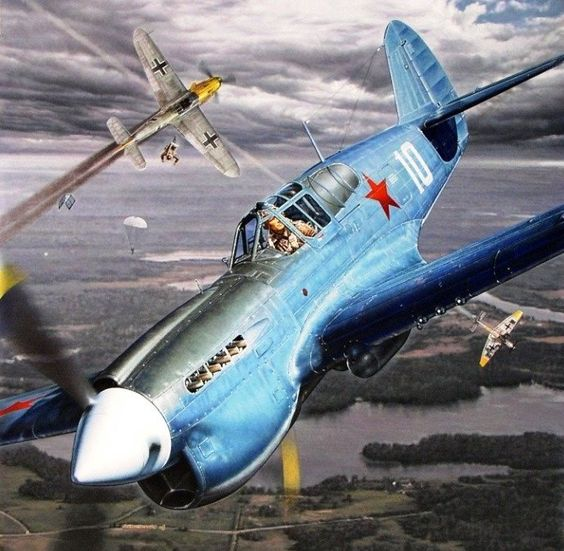
The Battle Over Stalingrad 1942
Introduction
Prior to the German Sixth Army capturing Stalingrad the Soviet Air Armies and Luftwaffe fought along a wide frontal area. Many air battles yielded many victories for skilled pilots and death for other. Many skilled aces compiled an enormous number of victories like Nowotny, Schack and Baronov as each side fought for air supremacy in the skies over Soviet Russia. This 1942 Luftwaffe vs VVS FSO series will place the fighter and bomber aircraft of the time in close combat. Victory can be swift and so can defeat, join us for the FSO team as we present the Eastern Front scenario in Operation "Fall Blau".
Country Split
Axis 50%
Allies 50%
Event Planeset
Luftwaffe
BF109G-2 (10) Max
BF110C-4B (8) Min
BF109F-4 (Unlimited)
JU87D (12) Min
HE111H (12) Min
VVS
Yak -7B (Unlimited)
P-40E (24) Min
P-39D (12) Max
IL-2 (12) Min
B-25C (12) Min
Ordnance Distribution (Loadouts)
If the aircraft is not listed with ordnance here, it may not carry any ordnance.
Luftwaffe
JU87D-3 = [1] 250Kg Bomb [4] 50 Kg Bombs
HE111H = [8] 250Kg Bombs - [2] 20mm MG FF Disabled
VVS
IL-2 Type 3 = [4] 100 Kg Bombs
B-25C = [6] 500 lb. Bombs - Glass nose only
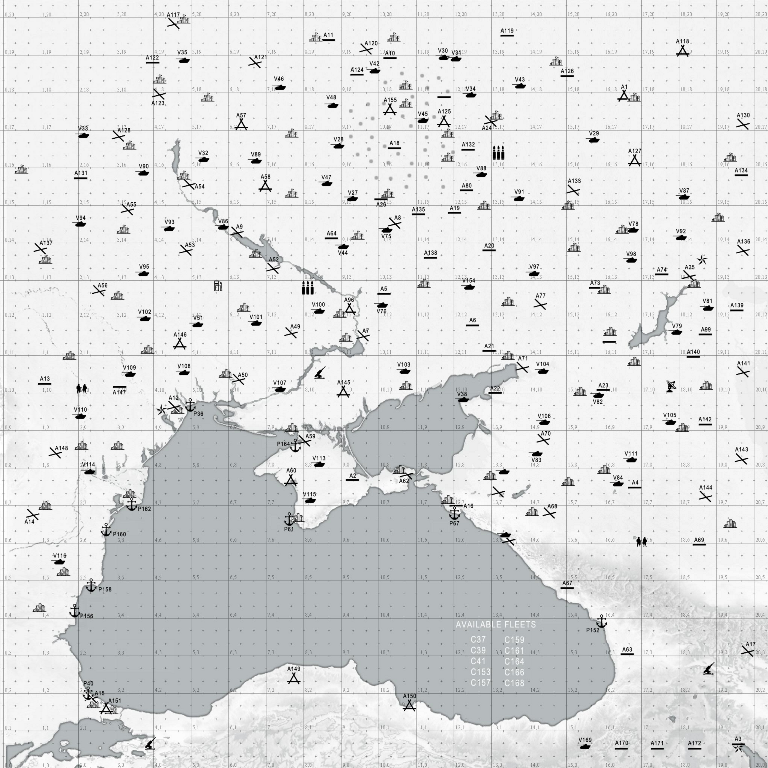
Terrain
Special Event Rules and Ordnance Restrictions
- This is a one life event. Pilots may not re-plane at their home airfields.
- Ordnance for each aircraft will be set by the setup CM in the hangar.
- Aircraft may rearm and refuel at any friendly base. Aircraft should be landed before frame’s end at any friendly base.
- All twin engine level bomber are restricted to an altitude below 18K.
- Twin engine level bombers may not dive bomb targets.
- All assaults must be made by no less than 12 attacking aircraft.
- Concerning an attack on a town target. There are no points awarded for less than a "White Flag" condition. Town will post "White Flag" at 0.7500 or 75% down.
- All destroyed objects stay down for the entire frame.
- Ground Strafing(Vulching) is permitted.
Scoring
Single Engine Fighter - 1 pt.
Single Engine Attack - 1.5 pts.
Twin Engine Bomber - 2 pts.
Hangars = 5 pts.
Barracks = 2 pts.
Ammo = 1 pt.
Fuel = 1 pt.
City objects - .5 pts.
Arena Settings
•Terrainmap: Blksea
•Fuel burn rate: 1.0
•Anti-aircraft gun strength: 0.5
•Bombsight calibration: AUTOMATIC (MA standard)
•Icons: 3.0K yards (9,000 feet)
•Sector Radar ("bar dar"): OFF
•Dot Radar: OFF
•Fighter and Bomber warning range: 52,800 feet (10 miles)
•Tower range set to 52,800 feet (for display only, to match the above setting)
•Haze range: 10 miles
•Friendlycollisions: OFF
•Enemy collisions: ON
•Kill shooter: OFF
•Stall Limiter: Set ON (Players may disable)
Wind:
Altitude Speed Direction
00 - 02K 0 NO WIND
02 - 10K 05 W -> E
10 - 18K 13 W -> E
18 - 26K 27 W -> E
26 - 30K 38 W -> E
30K+ -199 DOWNDRAFT
Arena Clock:
Frame 1 06:00 (6:00 AM, Morning)
Frame 2 11:00 (11:00 AM, Morning)
Frame 3 15:00 (3:00 PM, Afternoon)
ACE MISSIONS
Each side will have one mandatory Ace mission per frame. These frames will represent notable pilots of the time and theater. One pilot from each side will be designated an "Ace" Pilot. They must fly the Aces listed aircraft. The Aces must be relayed to the Admin CM before launch. They will be scored as follows.
Ace Pilot = 20 Points (Opponent Score)
Ace Pilot Kills = 20 Points
So for example if an Ace Pilot is shot down they are worth 20 points to the other side. Likewise, every victory an Ace Pilot lands they will be rewarded 20 points.
Luftwaffe
Frame 1 - BF110C-4b Leutnant Eduard Meyer, who received the Knight's Cross of the Iron Cross on 20 December 1941 for 18 aerial victories and 48 aircraft destroyed on the ground, as well as two tank kills.
Frame 2 - BF109F-4 Herman Graf - By January 24, 1942, Graf had scored his 41st victory and earned the Knight’s Cross of the Iron Cross. Four months later, on May 17, the Oak Leaves to the Knight’s Cross were bestowed on him when he achieved his 104th victory. The Swords to his Cross came two days later.
That fall, Graf dominated the air over Stalingrad in his Messerschmitt Me-109. In 30 days, he shot down 62 Soviet aircraft. After his tally reached 172, Graf was awarded the Diamonds to the Knight’s Cross on September 16, 1942. One of only nine pilots to receive this enviable decoration, Graf was reportedly proud that every one of his kills, in the course of more than 830 missions, was in air-to-air combat.
Frame 3 - BF109G-2 Alfred Franke was a German Luftwaffe ace and recipient of the Knight's Cross of the Iron Cross during World War II. The Knight's Cross of the Iron Cross was awarded to recognise extreme battlefield bravery or successful military leadership. On 9 September 1942, Alfred Franke was killed north of Stalingrad after dog-fighting with a Soviet Il-2 Shturmovik flown by Kapitan Pavel S. Vinogradov.[1] He was posthumously awarded the Knight's Cross on 29 October 1942 and was also promoted to Leutnant. During his career he was credited with 60 aerial victories. 4 on the Western Front and 56 on the Eastern Front.
VVS
Frame 1 - Yak-7B - Mikhail Baranov not only was a prominent ace, but also a capable leader: inspiring the men of 183 IAP's to score some 35 victories 1 July to 8 August 1942, more the remaining four regiments of the 269 IAD (6, 148, 254 and 864 IAPs) scored in total; 32. The 183 IAP however lost 12 Yak-1s (the whole division lost 47 Yaks and LaGGs).
Frame 2 - P-40E - Lt D.I. Koval of the 45th IAP gained ace status on the North-Caucasian front, shooting down six German aircraft flying a P-40.
Frame 3 - P-39D - Polkovnik Aleksey Semyonovich Smirnov - On 30 June 1942, the regiment was as one of the first regiments to be re-equipped with P-39D Airacobras. He was to fly this fighter with notable success during subsequent assignments on Voronezh, Northwest, Kalinin, 1st and 2nd Baltic and 3rd Byelorussian Fronts to come out of World War II as the regiment’s top ace. Smirnov ended the war with 4 biplane victories and a total of 34. These were claimed on 72 encounters on 457 sorties of which 100 were ground attacks. The last sortie and combat took place over East Prussia.
Designer Notes:
Designed by – AKWarhwk May 2017